
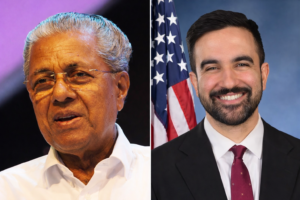
On November 1, 2025, the day commemorating formation of the Kerala state, Chief Minister Pinarayi Vijayan announced the success of Kerala’s ‘Extreme Poverty Eradication on Programme’ . Few days later, on November 6, 2025, Zohran Mamdani was elected as New York Mayor.
It is entirely fortuitous that these two events coincided on the same week. While Zohran’s impassioned campaign centred on tackling endemic homelessness and the lack of social security in New York City. Kerala had identified homelessness, and resultant insecurity, as one of the essential criteria for the definition of extreme poverty.
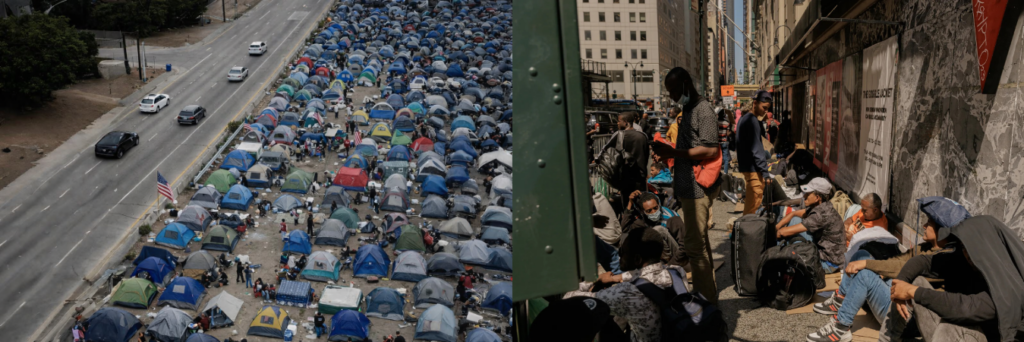
In New York City, 2% of the city’s population is homeless. Homelessness is the outcome of median cost of residential rent increasing beyond the median income of community. It is compounded by sudden job loss and lack of social security. In United States there is an ideological opposition to curb unchecked increase in rental prices. Mamdani came to power in a campaign that targeted this ‘ideological opposition’. Pinarayi Vijayan, in the southern state of Kerala, had promised something similar when he came to power in 2016. Of course, in Kerala, there is no ideological opposition for such a promise. But the challenge was how to deliver the promise. In Kerala Piravi day ( birthday of Kerala state), he announced the promise fulfilled.
In this article we shall discuss the historical process and ideological underpinning of this eventful story.
The Scale of Multidimensional Poverty Index
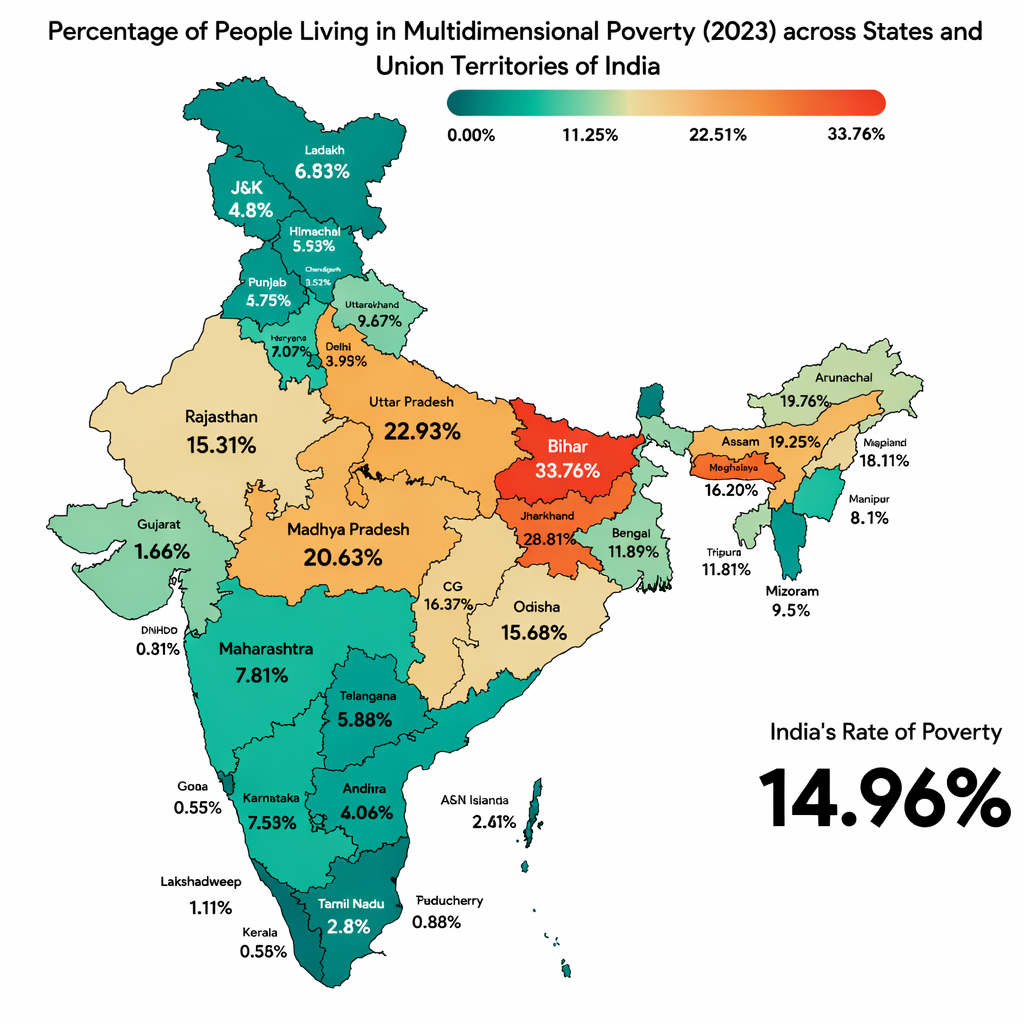
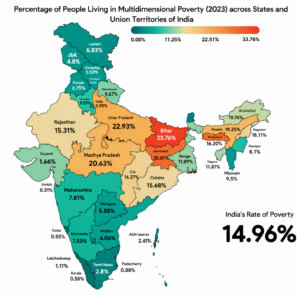
Kerala used the Multidimensional Poverty Index developed by Oxford Poverty and Human Development Initiative (OPHI) and the United Nations Development Programme. The MPI has replaced the Tendulkar Committee’s sole reliance on income as the criterion for assessing poverty. Based on Alkire and Foster’s framework, the MPI uses multiple parameters like standard of living, food security, education and economic activity for determining poverty. Each component of the MPI has strict deprivation cut-offs. A person is considered multidimensionally poor when their weighted ‘deprivation score’ crosses the established cut-off. The components are combined in assessing the final deprivation score. The MPI is derived from the intensity of the deprivation score and the headcount ratio. NITI Aayog’s report on the National MPI based on the 5th round of the National Family Health Survey (2019–21) estimates multidimensional poverty in Kerala at 0.5%. According to OPHI, 18% of the global population is poor by MPI criteria.
Kudumbashree Programme as the Bulwark of Rural Poverty Eradication and Women Empowerment
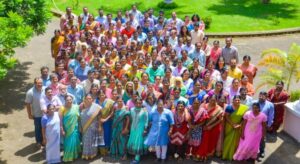
A systematic, program-driven poverty eradication drive by the government of Kerala started with the Kudumbashree programme launched in 1998. Implemented by the State Poverty Eradication Mission (SPEM), it envisaged women’s self-help groups as a bulwark against rural poverty. Kudumbashree has since grown into a state-wide network of 2.94 lakh Neighbourhood Groups with a membership of about 45 lakh women. It aims at poverty eradication through economic and social empowerment of women’s self-help entrepreneurship groups. It facilitated revolving microfinance and convergence with State and centrally sponsored programmes under the supervision of Community Development Societies (CDS) at the local self-government (LSG) level.
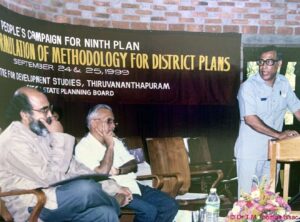
Kudumbashree’s institutional consolidation coincided with a significant reduction in poverty in Kerala. The absolute headcount ratio below the poverty line was 25.4% in 1993–94, while it declined to 11% by 2010 when the Kudumbashree programme was well established. Although there are multiple factors operating, Kudumbashree was the final common pathway for addrerssing residual poverty that is not resolved by long-term measures like education and skill development. Kudumbashree’s success is inseparable from the deepening of the Panchayati Raj system in Kerala. This in turn was incident to devolution of powers and resources to the LSGs and the success of the Peoples’ Planning Movement (PPM or Janakeeya Aasuthranam) initiated in 1996 under the guidance of the then Planning Board member (and later Finance Minister) Dr. T.M. Thomas Issac.
Peoples Planning Movement
PPM shifted planning, budgeting and implementation powers from State Secretariat to the LSGs. Kerala has devolved 35–40% of the State development budget to LSGs, the highest among Indian States. While Karnataka has devolved almost to the same extent, it did not develop the decentralised planning architecture that Kerala instituted in the late 1990s. Both Peoples’ Planning and Kudumbashree had bipartisan support in Kerala where the CPI(M)-led LDF and the Congress-led UDF alternated in power without reversing the central theme of decentralisation. Many of the flagship initiatives like the community kitchen during the COVID pandemic, disaster mapping during the 2018 floods, epidemiological reporting during epidemics, and welfare delivery in the state-wide palliative networks have been mediated through local bodies. LSG-governed regions held by opposition parties routinely perform on par with those held by the ruling front.
Extreme Poverty Eradication Programme as Consolidation of Targeted Schemes for Destitute
The Extreme Poverty Eradication Programme (EPEP) evolved from the Ashraya Project of 2002 and the Agathi Rahitha Kerala Programme (ARKP) of 2016. While these two programs targeted support (Ashraya) and eradication of destitution (ARKP), EPEP widened the scope to include those experiencing extreme deprivation as measured under MPI criteria. EPEP, launched in 2016, was a state-wide programme in mission mode, while the previous destitution-targeted programmes were managed at the local body level. There were state-wide surveys and central tracking dashboards ensuring rigorous monitoring.
EPEP defined the Extreme Poor as those who are unable to meet their basic needs of food, clothing, safe accommodation and basic income. This included those who are landless, homeless, women-headed jobless families, families with commercial sexual workers, families looked after by children below 14 years, unmarried older women, or families engaged in begging or sleeping in public places. Families with historical vulnerabilities like SC/ST and coastal communities or social deprivation like LGBTQIA+ persons, orphans and HIV-affected poor were also included.
As the Extreme Poor are those who are unable to advocate for themselves, and likely to be missed by the administrative machinery in a top-down implementation strategy, identification and mapping were devolved to the LSGs. The four overarching criteria for assessing households as Extreme Poor were lack of access to food, healthcare, safe dwelling and viable income.
Local Body Based Implementation of EPEP
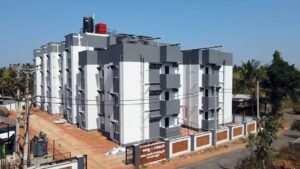
The State deployed its LSGs to facilitate the programme. The entire exercise involved about 2,40,100 training sessions. From the 1,18,309 households identified in the focus group discussions, 64,006 households were finalised. Kerala Institute of Local Administration (KILA) estimates this as 0.73% of the State population. The higher number of poor identified in the EPEP is likely due to complete enumeration and granular ‘tail capture’ of invisible vulnerable groups. LSGs prepared microplans tailored to each household. These include assistance in getting livelihood, healthcare access, house construction and other survival needs. Inter-departmental convergence enabled unified service delivery that required coordinated decision-making. Of note is the LIFE Mission, which has constructed nearly 4.5 lakh houses, and the state-wide community kitchen that provided food to the locally deprived.
The unique feature of EPEP is its person-specific design in addressing deprivation. This is almost impossible in a traditional top-down poverty alleviation framework like the Integrated Rural Development Programme, Jawahar Rozgar Yojana and Antyodaya Anna Yojana.
On the social intervention front, it is the success of a unique model of participatory democracy, decentralisation of power, women’s empowerment programmes and community mobilisation through bipartisan local bodies. The malady of leakage of program fund, famously described by Rajiv Gandhi as 85% of the welfare schemes, is effectively plugged when Panchayati Raj Institutions are operationalised by proper devolution of power and resources.
EPEP as Textbook Copy of Jack Rothman’s Models of Community Intervention
EPEP exemplifies Jack Rothman’s locality development model, where community participation, consensus and social planning are foundational. It would not have been possible without the development architecture created since the late 1990s. But at the core of the programme is the attention given to the voiceless minority whose very disability is their silence.

In the New York mayoral election campaign, Zohran Mamdani, a former foreclosure-prevention counsellor, lent voice to the homeless in New York City. In Kerala, Chief Minister Pinarayi Vijayan made the announcement of ‘eradication’ of extreme poverty as one of the rallying points for his third term. Both resonate with the assertion of the French Revolutionary Thomas Paine in his seminal treatise, Rights of Man: “It is not charity, but a right; not bounty, but justice.” While critics may question the claim of ‘eradicating’ extreme poverty, given the dynamic nature of poverty, what stands out is Kerala’s tangible, decades-long commitment to pursuing what many once considered impossible. Such sustained effort is possible only through deep ideological conviction.
Hits: 662